
What this analysis reveals about subtitle impact in 2026:
- Current platform data showing 85% of social videos watched muted, with mobile accounting for 71% of digital engagement
- Measurable performance improvements when subtitles are implemented across different content types
- Multi-dimensional returns beyond engagement: accessibility compliance, search visibility, and international reach expansion
- Five critical implementation errors that undermine subtitle effectiveness and how to avoid them
The silent viewer revolution: Why are 85% of social media videos watched without sound?
The shift to soundless consumption isn’t speculative. Manchester Digital’s 2025 research across major platforms demonstrates that the overwhelming majority of viewers scroll through feeds without ever activating audio. On LinkedIn, where B2B marketers invest heavily in thought leadership content, videos autoplay muted. Instagram Stories launch silently. YouTube Shorts default to sound-off for users browsing in public spaces. The pattern holds consistent across platforms because it reflects fundamental changes in how and where audiences consume video content.
Mobile dominance drives this behaviour. The IAB UK data reveals that 71% of all UK digital advertising spend now targets mobile devices, representing £13.3 billion in 2025. People watch videos during commutes, in office environments, while queuing, in cafés — contexts where activating sound proves socially awkward or practically impossible. The infrastructure of modern content consumption actively discourages audio, yet many content strategies still prioritise voiceover and music as primary information delivery mechanisms. Broader challenges around fixing video viewer retention become exponentially harder when your opening hook relies entirely on audio that never plays.
85%
Proportion of social media videos consumed without sound across platforms in 2025

Measurable impact: Engagement metrics before and after subtitle implementation
The business case for subtitles extends beyond accessibility virtue signalling. Research consistently demonstrates that subtitled videos achieve substantially higher completion rates compared to equivalent content without text overlays, with the magnitude of improvement varying by content type, platform, and audience segment. Mobile viewers show the most pronounced response, as text provides the only pathway to comprehension in sound-off contexts.
Video’s rising share of digital investment — now comprising 23% of total UK digital ad spend according to IAB UK data — reflects advertiser recognition that properly optimised video delivers measurable returns. Within social media specifically, video represents 59% of total investment precisely because engagement metrics justify the allocation when content is formatted for silent consumption. The organisations seeing these returns have fundamentally restructured their video strategy around subtitle-first approaches rather than treating captions as an afterthought accessibility feature.
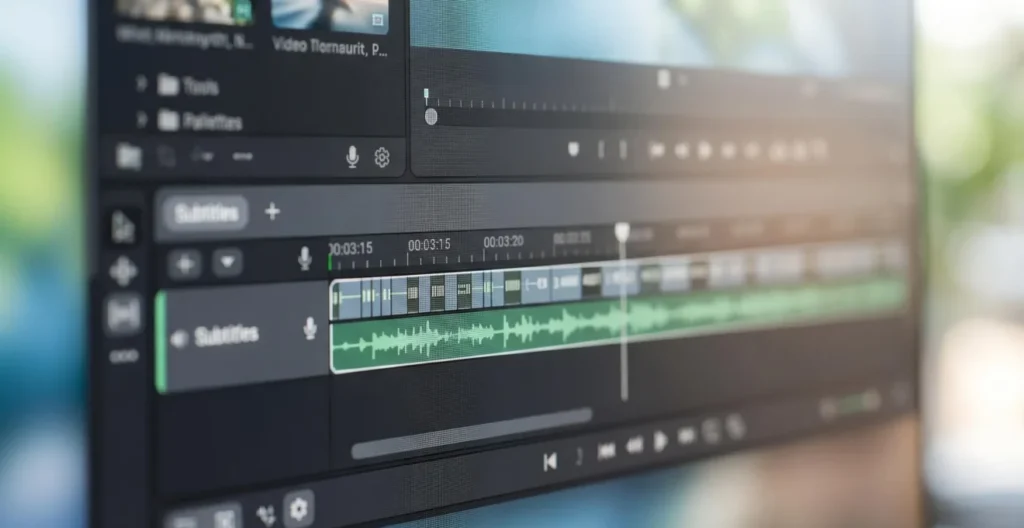
For content teams managing production workflows at scale, the efficiency question becomes critical. Manual subtitle creation for a library of 50+ videos represents weeks of transcription work and substantial freelance costs. This is where automatic subtitle generator technology transforms the implementation barrier from « eventually, when budget allows » to « deploy across entire library this week. » PlayPlay’s AI-powered solution analyses audio across multiple video formats (MP4, MOV, MKV, MPG) and generates synchronised subtitles in seconds, with support for translation into more than 100 languages and real-time editing directly on the platform. The comparative data below contrasts typical performance baselines for videos without subtitles against observed improvements following subtitle implementation. Each metric row demonstrates the engagement dimension where text-based comprehension delivers measurable lift.
| Metric | Without Subtitles (typical baseline) | With Subtitles (observed improvement) | Primary benefit driver |
|---|---|---|---|
| Mobile completion rate | Typically low retention | Significantly higher retention | Text provides comprehension without audio requirement |
| Social media engagement | Baseline platform average | Measurably elevated interaction | Viewers understand message context sufficiently to respond |
| Average watch time | Limited engagement duration | Substantially extended duration | Subtitle pacing guides viewing rhythm, reducing early drop-off |
| LinkedIn video performance | Below 15% completion | Substantial improvement observed | Professional viewing contexts (offices, meetings) demand silent consumption |
These percentage improvements materialise differently depending on content type, platform mix, and audience profile. Translating aggregate statistics into operational context requires examining specific implementation scenarios with concrete baseline metrics and post-deployment tracking. The following case illustrates how a mid-sized organisation approached subtitle deployment systematically, measured results across multiple engagement dimensions, and quantified ROI within a single fiscal quarter.
A concrete B2B implementation scenario illustrates these principles in operational practice:
Implementation scenario: B2B technology company subtitle deployment
Consider a mid-sized software company with 150 employees producing educational content for LinkedIn. Initial video completion rates hovered around 14%, with engagement metrics (reactions, comments, shares) falling below platform averages despite professional production quality. The marketing director recognised that office-based viewers — the core target audience — consumed LinkedIn content during work hours with sound disabled by default.
The team deployed automatic subtitle generation across their existing library of 80+ product explanation and thought leadership videos. Within the first quarter following implementation, completion rates nearly tripled. Engagement interactions increased by approximately two-thirds, and total watch time rose by over one-third.
The critical insight: subtitle implementation didn’t require re-filming content or additional production budget. The entire transformation occurred through text layer addition to existing assets, with as measured by the IAB/PwC Full Year 2025 benchmark report, the broader digital advertising industry’s 13.9% year-over-year growth reflecting similar optimisation investments paying measurable dividends.
Beyond engagement: Accessibility, SEO, and global reach advantages
Subtitle implementation delivers returns across multiple dimensions simultaneously. UK organisations face specific legal requirements under the Equality Act 2010 and Public Sector Bodies Accessibility Regulations 2018, which mandate accessible video content for public sector entities and establish broader expectations for private sector digital properties. WCAG 2.1 Level AA compliance standards specifically require captions for pre-recorded video content, with subtitle quality and accuracy forming part of accessibility audit criteria.
UK accessibility compliance essentials: WCAG 2.1 Level AA standards establish subtitle requirements for video content, whilst the Equality Act 2010 creates legal obligations for organisations to provide accessible digital materials. Public sector bodies face specific requirements under the 2018 Accessibility Regulations, with enforcement mechanisms including formal complaints and potential legal action. Beyond legal compliance, approximately 11 million UK residents report some form of hearing loss, representing a substantial audience segment that relies entirely on text-based content comprehension.
Search optimisation represents another dimension where subtitles contribute measurable value. Search engines index subtitle text alongside video metadata, expanding the keyword surface area that connects content to relevant queries. A video discussing « cloud security compliance frameworks » gains search visibility not just through title and description tags, but through every mention of specific frameworks, regulations, and technical terminology appearing in subtitle text. This indexing advantage compounds over time as content libraries grow.
International expansion through subtitle translation unlocks markets without requiring multilingual video production. The platform’s support for more than 100 languages enables a single English-language video to serve French, German, Spanish, Mandarin, and Arabic audiences through translated subtitle tracks. This approach proves substantially more cost-effective than filming separate language versions, particularly for content with limited shelf life such as product updates or quarterly business reviews. The thousands of enterprises adopting modern automatic subtitle solutions increasingly deploy this multilingual strategy to expand addressable audiences without proportional production budget increases.
The multiplier effect becomes clear when these benefits compound: a single subtitled video simultaneously improves mobile engagement, satisfies accessibility requirements, enhances search discoverability, and enables international deployment. Each dimension generates independent ROI, whilst the combined impact transforms video from a single-purpose asset into a multi-functional content investment. Modern approaches to creating professional videos online increasingly integrate subtitle generation as a default production step rather than an optional enhancement, recognising these compounding advantages.
Implementation pitfalls: Five subtitle mistakes that reduce rather than boost engagement
Not all subtitle implementations deliver positive results. Poorly executed captions actively harm viewer experience, creating the paradoxical outcome where subtitled content underperforms equivalent videos with no text at all. Understanding these failure modes proves as critical as recognising subtitle benefits.
Critical errors that undermine subtitle effectiveness:
1. Font sizes below 16 pixels for mobile devices: Text that appears readable on desktop screens becomes illegible on mobile devices, where 71% of video consumption occurs. Minimum 16-pixel font sizing ensures readability across all viewing contexts.
2. Timing synchronisation delays exceeding half a second: When subtitle text appears noticeably before or after corresponding audio, viewers experience cognitive dissonance that they interpret as low production quality and careless execution.
3. Subtitle positioning that obscures key visual elements: Text overlays that block product demonstrations, speaker faces, on-screen graphics, or calls-to-action force viewers to choose between reading subtitles and seeing important content, reducing effectiveness of both.
4. Transcription accuracy errors for specialised terminology: Mistakes in brand names, technical vocabulary, or industry jargon undermine credibility and suggest careless content production. Automated transcription requires human review focusing specifically on proper nouns and domain-specific language.
5. Insufficient contrast ratios and excessive line length: Text colour without adequate contrast against video backgrounds creates readability problems, particularly for viewers with visual impairments. WCAG guidelines specify minimum contrast ratios of 4.5:1, often necessitating semi-transparent background boxes. Subtitle lines exceeding 42 characters force excessive horizontal eye movement, slowing reading speed and increasing cognitive load.
The accuracy challenge deserves particular attention. First-generation automatic transcription tools produced error rates that required extensive manual correction, often negating time-saving advantages. Modern AI-powered solutions achieve substantially higher accuracy for clear audio in major languages, though performance still varies based on audio quality, accents, and technical vocabulary. The workflow solution involves rapid automated generation followed by targeted human review focusing on proper nouns, industry terms, and brand-specific language rather than word-by-word verification of common vocabulary.
Your subtitle quality assurance framework
- Verify minimum 16-pixel font size for mobile readability across all target platforms
- Confirm subtitle timing synchronisation remains within 0.5-second tolerance of audio
- Test subtitle positioning to ensure no overlap with key visual elements, faces, or CTAs
- Review automated transcription for accuracy of brand names, technical terms, and industry jargon
- Validate minimum 4.5:1 contrast ratio between subtitle text and video background
- Limit line length to maximum 42 characters for optimal reading speed and comprehension
- Export subtitle files in platform-appropriate formats (SRT, VTT, or embedded) for multi-channel distribution